
Taylor County Court Docket Lookup
Taylor County Court Docket searches are practical because the clerk of courts office in Medford handles the records, the fees, and several services that sit around the docket itself. If you are looking for a case, you can start online and then move to the county office when you need the document or a local answer. Taylor County also handles passport applications, including photos, which is a reminder that the office does more than store files. That mix of record work and public service makes the county page useful when you need to locate a docket and then decide what to ask for next.
Taylor County Court Docket Search
Start with Wisconsin Circuit Court Access. The portal gives you the public circuit docket view and lets you search by case number, party name, business name, or attorney name. For Taylor County, that is the quickest way to see whether the file exists and what public events are already entered. If you are checking a hearing, matching a notice, or confirming that a filing made it into the system, the public docket is the right starting point. It gives you the basic case trail without making you call the office first.
The docket view is only part of the picture. It shows the public event history, but not the paper file itself. Taylor County’s clerk office still handles the actual records, the fee collection, and the court record maintenance work. That matters if the case is older, if the record is being requested for another office, or if you need a certified copy instead of a docket line. The online search helps you locate the file, while the clerk helps you finish the request.
Taylor County Records
Taylor County Clerk of Courts Jill Scheithauer is listed at 224 S. 2nd Street in Medford, WI 54451. The county research says the office handles passport applications, including photos, jury management, court records maintenance, and fee collection. Those services matter because they show the office is the local hub for more than one part of the record process. If you need a docket copy, the clerk is the record source. If you need a passport appointment or another courthouse service, the same office helps with that too. That makes the office easy to remember and easy to use.
Image source: Taylor County Legal Resources.
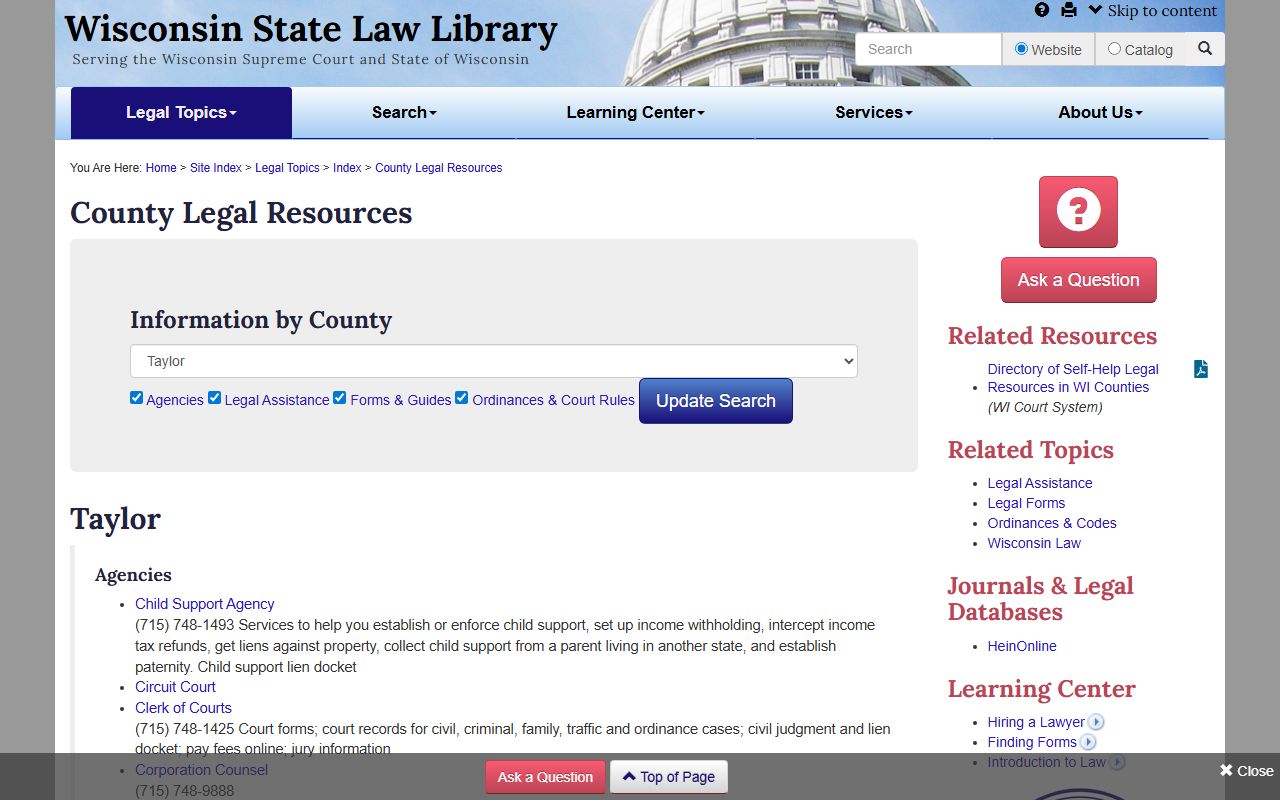
This image points back to the county legal resources page and gives Taylor County users a local law-library reference that fits well with the clerk office and the county’s public service setup.
Taylor County is straightforward for records work once you know the office role. The docket tells you which case exists. The clerk office tells you what copy can be released and whether any local service detail applies. That is a good fit for users who want a clean county-level path without having to guess which department owns which part of the file.
Taylor County Court Docket Copies
Copy fees in Taylor County follow the statewide fee baseline in Wis. Stat. § 814.61. That means the county uses the same Wisconsin structure for ordinary copies and certified documents. A plain page copy costs less than a certified record, and the clerk can explain the exact amount once it knows what you want. If you need a docket sheet, a judgment, or a certified order, be specific about which one matters. The office can only price and prepare the document you request.
It helps to think of Taylor County as an office with multiple lanes. Passport work is one lane. Jury management is another. Court records maintenance and fee collection are the docket lane. If you keep your request focused, the clerk can move faster. If you do not have a case number, add names and dates so the office can narrow the search. That saves time and keeps the request from becoming broader than the record you really want.
For older files, the same rule applies. Ask whether the record is active, archived, or available electronically. If the document is ready, the office can tell you what to pay and how to get it. If the file needs retrieval, the clerk can tell you how long that may take. That is the normal county process, and Taylor County is set up to handle it in a clear way.
Open Records and Retention
Wisconsin open records law in Wis. Stat. § 19.31 explains why Taylor County Court Docket records are generally available to the public. Access should be the default, so the docket can usually be inspected unless a statutory or court order limit applies. That broad rule makes the docket a strong starting point, but it does not mean every file is open in full. Sealed matters, juvenile records, and other protected materials still have limits, and the clerk must follow those limits.
Wisconsin Supreme Court Rule 72 explains how records are retained and maintained over time. That matters in Taylor County because older files may be archived, and the docket may be the only quick public view before you ask for a copy. The rule also supports electronic recordkeeping with secure backup. That helps the county preserve access while keeping the records system organized. If the file is not at the counter, it may still be available through the retention system.
In practical terms, the open records law and the retention rule answer two different questions. One tells you whether you can search. The other tells you how the record is kept. If the record is public but old, the clerk can help you retrieve it. If the record is restricted, the clerk can explain the limit without giving legal advice. That is the normal shape of court record access in Wisconsin.
Taylor County Court Docket Help
If a Taylor County Court Docket search leads to a criminal case and the person needs counsel, the Wisconsin State Public Defender is the statewide office for eligible defense work. If the issue is criminal history data instead of the court file, the Wisconsin Department of Justice Crime Information Bureau is a separate resource. Those offices are useful when the question goes beyond the docket and turns into legal representation or background data.
Taylor County’s extra services can make the clerk office feel busier than a plain records counter, but the record path is still clear. Use the docket to find the case, use the clerk to request the record, and use the state services only if the issue changes into representation or criminal history. That keeps the process well ordered and avoids mixing up services that are not supposed to do the same job.
For most Taylor County searches, that is enough. The docket gets you to the file, the clerk gets you the copy, and the county office keeps the public service side moving without making the search harder than it needs to be.