
Sawyer County Court Docket Guide
Sawyer County Court Docket searches are practical when you know the county office and the case type, because the public docket will usually get you to the right file fast. Sawyer County is based in Hayward, and the clerk of courts office is close enough to keep the process simple once you have a party name or case number. The county research also includes a couple of important local limits, so the search should not stop at the docket view. If you need a bond payment, a small claims step, or a local copy, the county office rules matter just as much as the online record.
Sawyer County Court Docket Search
Use Wisconsin Circuit Court Access first. That portal is the statewide public view for circuit docket information, and it lets you search by case number, party name, business name, or attorney name. For Sawyer County, it gives you a quick way to confirm whether a case exists and what docket events are public. That is the cleanest path when you are trying to match a hearing notice, verify a filing, or decide whether you need to contact the clerk. The search is broad, but the result is usually specific enough to guide the next step.
WCCA does not hand you the paper file. It gives you the docket. That matters in Sawyer County because some local issues, such as bond payments and small claims service, have office rules that are not visible on the public screen. If the record is recent or if the case has a local procedure attached to it, the clerk can clarify what the office will accept. The docket is the search tool. The office is the place where the case action turns into a copy, a payment, or a process step.
Sawyer County Records
Sawyer County Clerk of Courts Marge Kelsey is listed at 10610 Main Street in Hayward, WI 54843, which gives the county a clear record point for follow-up questions. The county research also says bond money must be paid with cash or cashier’s check only, online programs are not set up for bond money, and personal service is required for all small claims. Those are the kinds of local rules that make a county page useful. The docket may tell you the case exists, but the clerk tells you how to move the case forward.
Image source: Sawyer County Legal Resources.
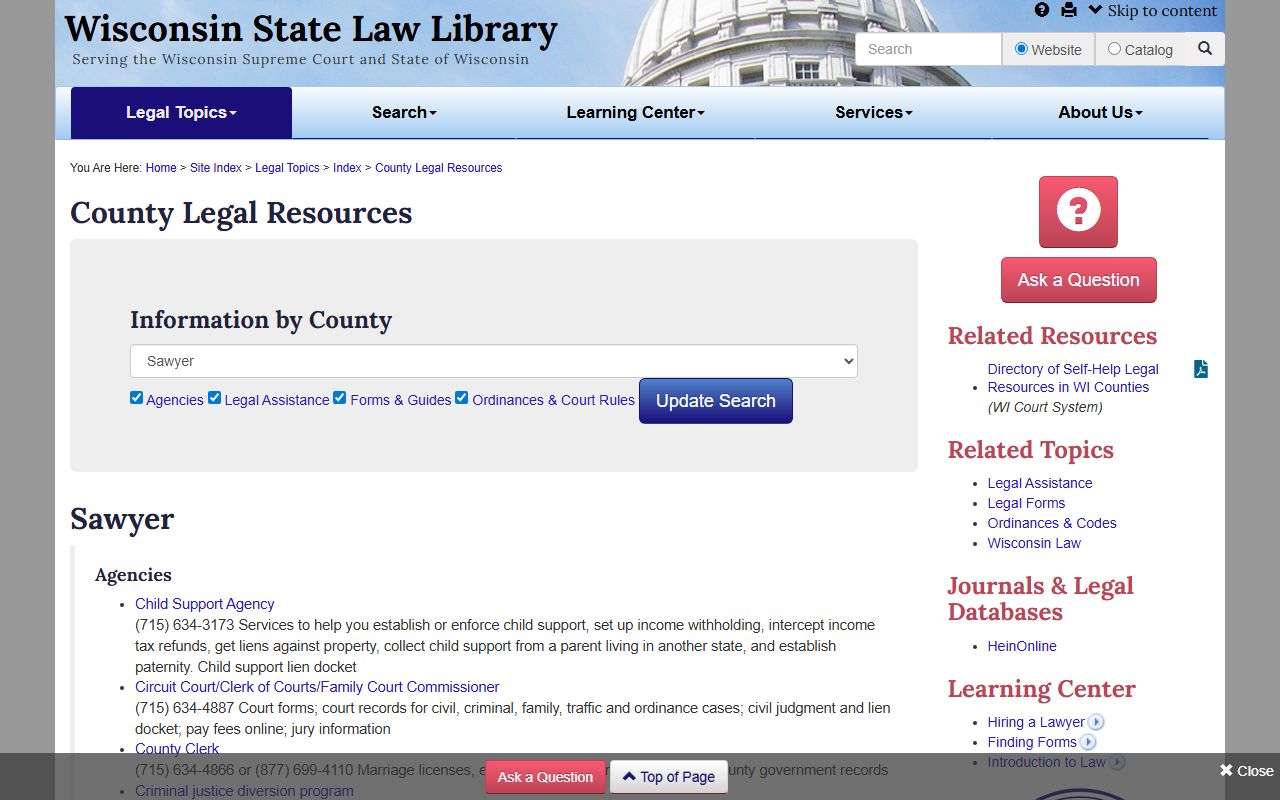
This image points back to the county legal resources page, which is a good local reminder that Sawyer County users may need both the clerk office and the county legal resource page when they are trying to understand a docket entry.
Sawyer County is a county where process details matter. If you need to post a bond, the payment method is limited. If you are starting a small claims action, personal service is required. Those rules are not always obvious from the docket itself. That is why a county-level records page is helpful. It keeps the search from stopping at a case number and points you toward the office behavior that actually matters.
Sawyer County Court Docket Copies
The copy baseline is the statewide fee rule in Wis. Stat. § 814.61. Sawyer County follows the same Wisconsin structure for ordinary page copies and certified documents, so the clerk can explain the total once the office knows what paper you want and how many pages the file contains. That means the practical question is not just cost. It is also whether you need the whole file, a docket sheet, or a certified order. If you ask for the right thing the first time, the office can usually move faster.
When you make a request, give the party names and the case number if you have it. If you do not have a case number, include the date range and the type of case so the office can narrow the search. Sawyer County is small enough that this often works well, but you still want to be specific. A bond payment request is not the same as a copy request. A small claims service question is not the same as a docket printout. The office can help with the record, but the request needs to match the task.
The county research does not suggest a special local records maze. That is good news. It means the county clerk and the statewide docket portal work together in a pretty ordinary way. The search gets you to the case. The records office gives you the document or the local rule explanation. That simple split is usually enough to get the answer without wasted back-and-forth.
Open Records and Retention
Wisconsin open records law in Wis. Stat. § 19.31 is the reason Sawyer County Court Docket information is generally searchable. Access is the rule, so the public docket is open in most ordinary matters. That said, the rule still leaves room for confidential or sealed matters, so a docket search does not mean every file is open in full. The public record view is broad, but the county still has to respect the limits that come with juvenile records, sealed cases, and other protected material.
Wisconsin Supreme Court Rule 72 explains how those records are kept over time. That is useful in Sawyer County because the docket can still point you to an older file even when the paper record is archived. The rule allows electronic records with proper security and backup, and that helps preserve access while keeping the records system organized. If the file is not at the counter, that usually means it needs to be retrieved, not that it is lost.
The retention rule and the open records law are the two main pieces of the record picture. One tells you why the docket can be public. The other tells you why an older file may still exist and may still be available. If the clerk says a record is restricted or stored, that is a records answer, not a dead end. It just means the search moved from the public screen to the office workflow.
Sawyer County Court Docket Help
If a Sawyer County Court Docket search leads to a criminal case and the person needs defense representation, the Wisconsin State Public Defender is the statewide office for eligible defendants. If the question is criminal history data rather than court records, the Wisconsin Department of Justice Crime Information Bureau is a separate resource. Those offices are useful, but they are not the same thing as the county clerk or the public docket.
Sawyer County’s local process is plain enough once you know the rules. Bond payments are limited to cash or cashier’s check, online programs do not handle bond money, and small claims require personal service. Those details matter because a docket entry can lead to an action step rather than just a copy request. The clerk office can explain the file and the courthouse rule, while the statewide portal gives you the case trail.
If you keep the search narrow, Sawyer County is a manageable place to work. Check the docket, confirm the office, and then ask for the exact record or court step you need. That approach keeps the process moving without turning it into a bigger problem than it is.