
Rusk County Court Docket Search
Rusk County Court Docket searches work best when you start with the public statewide portal and then move to the county clerk for anything you need to hold in your hand. Rusk County is centered in Ladysmith, and the county record path is simple enough that most users can get from a name or case number to a useful docket view without much guesswork. The local office also matters because some searches end with a request for a copy, a status check, or a better explanation of what the docket line actually means. The county process is direct, but it still helps to follow the right order.
Rusk County Court Docket Search
The first stop is Wisconsin Circuit Court Access. That site gives you the public docket view for circuit cases across Wisconsin, including Rusk County. You can search by case number, party name, business name, or attorney name, which is enough to find most public records without calling the office first. For a county search, that is the cleanest way to answer the basic question of whether a file exists and what public events are on the docket. The portal is simple to use and fast to check, especially if you are working from a notice or a rough case clue.
WCCA is only the docket view. It shows the public case trail, but it does not replace the actual court file. That difference matters in Rusk County because the clerk office still controls the paper record, the copies, and the local explanation of what is available. If a filing is new, the online record may lag behind the courthouse. If a file is older, the clerk may need to pull it from storage. The search gets you to the case, but the office finishes the record work.
Rusk County Records
Rusk County’s clerk of courts office is at 311 Miner Avenue East in Ladysmith, WI 54848, with the phone number (715) 532-2108. The county research also gives a mission statement that says staff treat the people they help and serve with dignity, fairness, and sensitivity. That detail says a lot about how the office approaches record work. It is not only a file room. It is the local place where people can ask for court records, make sense of a docket line, and follow up on a case without having to guess at the next step.
Image source: Rusk County Legal Resources.
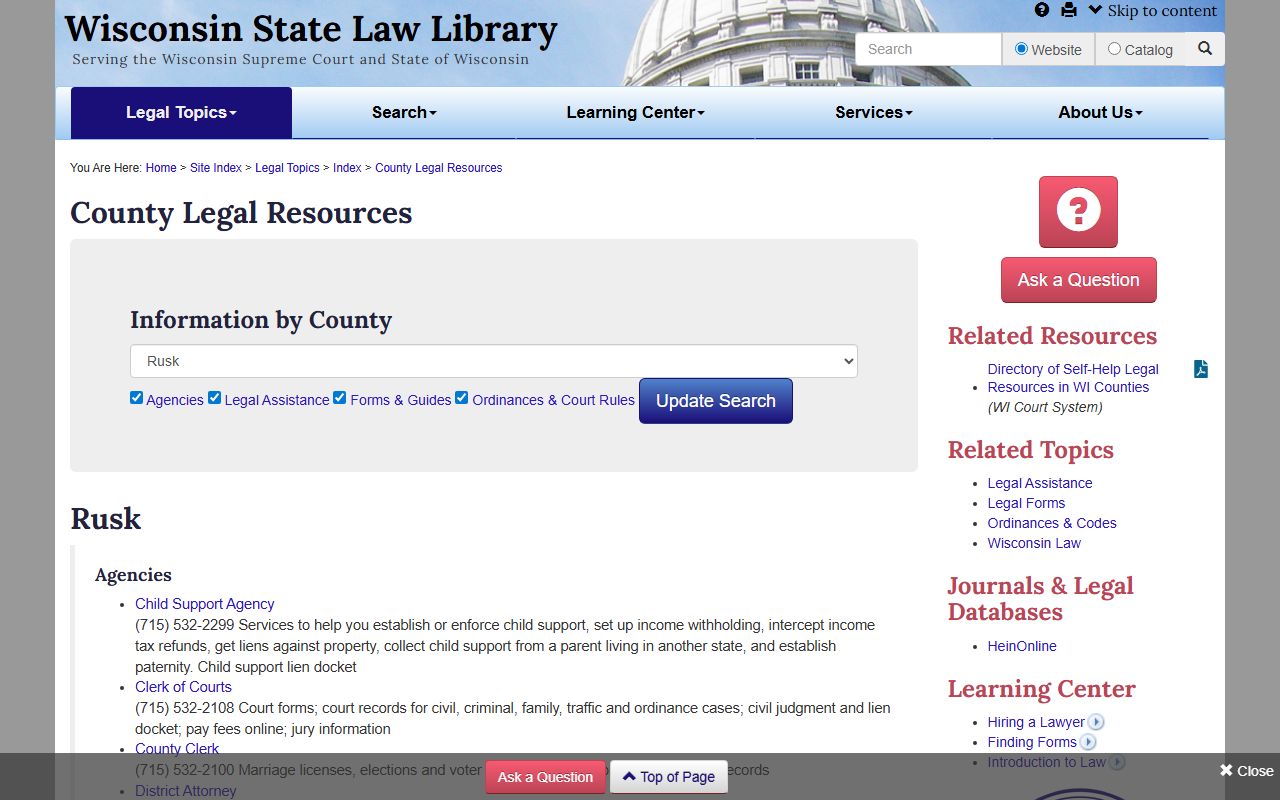
This image points back to the county legal resources page, which is a practical local starting point when you want the county office, the courthouse location, and a simple route into a records request.
Rusk County does not need a complicated record workflow to be useful. The docket gives you the name, the case number, and the public event history. The clerk office gives you the paper copy or the local answer. That is enough for most ordinary searches, and it keeps the process from turning into a long hunt for one page or one order. If the case involves a family or criminal matter, the clerk can still help you locate the public part of the file even when some details remain restricted.
Rusk County Court Docket Copies
Copy fees in Wisconsin follow the statewide statutory rule in Wis. Stat. § 814.61. That is the baseline Rusk County uses for page copies and certified documents. In practice, that means plain copies are cheaper than certified copies, and the clerk can tell you the total once the office knows what you want and how many pages are involved. The county research does not add a special local fee schedule, so the state standard is the right place to start.
If you are making a request, keep it tight. Give the party name, the case number if you have it, the filing year if you know it, and the exact document title if you only need one paper. That matters because a docket search and a copy request are not the same thing. The docket tells you where to look. The copy request tells the clerk what to pull. When you make the ask specific, the office can answer faster and you avoid paying for more search time than you need.
Rusk County record work is usually in person or by mail, depending on what the office accepts and how the file is stored. If you need a certified copy for another court or for an agency, say that up front. If you only need a docket sheet for your own use, say that too. The clerk can then tell you whether the request will be simple or whether the file needs to be retrieved first. That is the kind of practical detail that saves time in a small county office.
Open Records and Retention
Wisconsin’s open records policy starts with Wis. Stat. § 19.31. The rule says public access is the default and denial is the exception, which is why a Rusk County Court Docket search can usually show you public case activity. That does not mean every document is open. Sealed cases, juvenile matters, and other protected files can still be limited. But for ordinary civil, criminal, or traffic matters, the docket is generally available and useful for tracking the case trail.
Wisconsin Supreme Court Rule 72 explains how court records are kept over time. Clerks must follow retention schedules, and the records may be maintained electronically or in another approved form with secure backup. For Rusk County, that means a case can still be alive in the records system even when the file is no longer sitting on the counter. The docket may be public, but the paper copy may live in storage until the clerk retrieves it. That is normal and does not mean the record is gone.
The open records law and the retention rule work together. One explains why you can search. The other explains why older files still matter. If you run into a case that is archived or partly restricted, the clerk can tell you what the office can release and what it cannot. That is often enough to decide whether you need a copy, a docket printout, or a legal referral.
Rusk County Court Docket Help
Rusk County Court Docket searches can lead into criminal or family case questions, and those are not always record questions. If the problem is legal representation, the Wisconsin State Public Defender is the statewide office for eligible defendants. If the question is criminal history data, the Wisconsin Department of Justice Crime Information Bureau is a separate statewide resource. Those offices do different work from the clerk. They are useful, but they are not a substitute for the county docket or the records office.
When you need help with the record itself, the county clerk remains the first stop. When you need legal advice, the clerk cannot cross that line. That is why the local office and the statewide services should be used in sequence. Search the docket first, confirm the office, then decide whether you need a copy, a public defender, or a background-check style resource. That order keeps the process manageable and prevents the search from drifting away from the real record issue.
Rusk County works well for users who keep the search narrow. The county has a clear office, a clear court location, and a public docket path that does not need a lot of extra explanation. That makes the search practical for people who just want to find the case and ask for the right page.