
Search Iowa County Court Docket
Iowa County Court Docket searches are straightforward if you start with the statewide portal and then move to the county clerk when you need the paper record. Iowa County has a clear courthouse location in Dodgeville and a detailed official department page, so the search path is usually efficient once you know the party name or case number. The docket view helps you see the case trail. The clerk’s office helps you get the copies, dates, and local answers that the online page cannot always provide. That two-step approach saves time and keeps the record request focused.
Iowa County Court Docket Search
Use the official county page at Iowa County Clerk of Courts for the local office, then use Wisconsin Circuit Court Access for the public docket search. The county research says records are searchable through WCCA and can be requested in person or by mail. It also notes that requests should include names of the parties, filing dates, and case numbers if available. That makes the county process easy to map. Start with the online docket, then use the office if you need the actual document or a confirmation from staff.
WCCA is a docket tool, not a file room. It shows case summaries, party information, and case events, but not every scanned document. That matters in Iowa County because the clerk office still handles the documents that people need for hearings, appeals, certified use, or personal records. If the case is new, the online view may lag. If the file is older, the office may need time to pull it. The public search is useful, but it is still only the first part of the process.
The statewide system keeps the search pattern consistent across Wisconsin. That means an Iowa County search works like a search anywhere else in the state. Once you learn how the docket is arranged, you can move from one county to another without learning a new platform. That is one reason WCCA is the right first stop for Iowa County Court Docket work.
Iowa County Records
The courthouse sits at 222 North Iowa Street in Dodgeville, and the local office handles civil, criminal, family, traffic, and ordinance records. The county research also shows the clerk’s office manages the civil judgment and lien docket, jury information, and online fee payment. That is a broad set of services for a county office, and it makes the clerk the key place to go after the online docket search. The public docket tells you what exists. The clerk tells you what can be copied and how the local office wants the request submitted.
Image source: Iowa County Clerk of Courts.
This county image points to the official clerk page, which is useful if you want the direct local office rather than a statewide search page.
Image source: Iowa County Legal Resources.
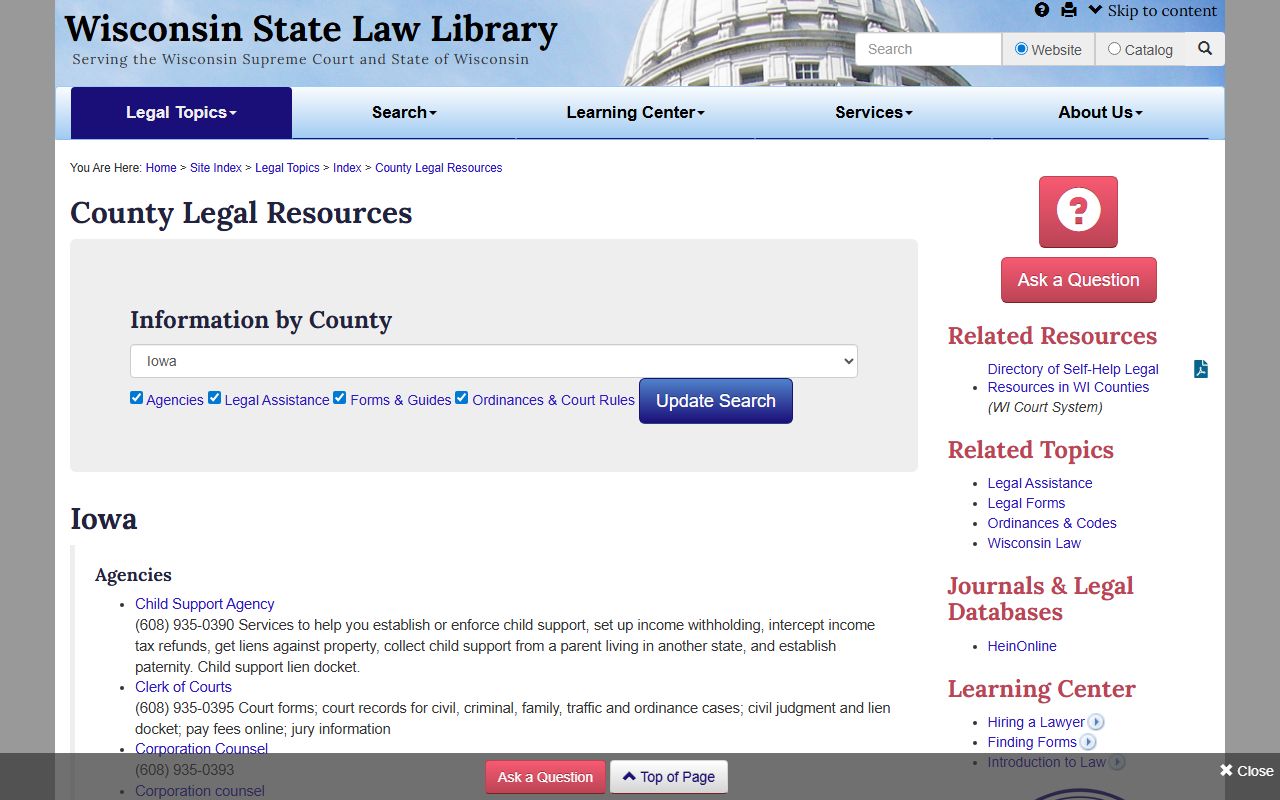
This second image links back to the county legal resources page, which is a good backup path when you want a county-level legal reference before you start a records request.
The county office can also help you match the docket to the right department. Iowa County lists child support, the county clerk, the district attorney, drug treatment court, register in probate, and register of deeds. That matters because court work often crosses office lines. A docket entry may lead you to probate, family, or child support records, and each office has its own role. The clerk remains the record hub, but the county structure around it can answer related questions quickly.
Iowa County Court Docket Copies
The copy fee baseline is the standard Wisconsin rate in Wis. Stat. § 814.61. That means Iowa County follows the familiar $1.25 per page copy rule and the certification fee structure used across the state. The county research also says payment is required before copies are released. That is an important detail, because it tells you to bring the right payment plan with your request instead of expecting the office to mail records first and bill later.
For the best result, give the clerk names, dates, and case numbers if you have them. The county notes specifically say requests should provide names of the parties, filing dates, and case numbers. That is the kind of detail that keeps the office from searching the wrong file or pulling too much at once. If you only need a docket copy, say that. If you need the underlying order or judgment, say that too. The clerk can only copy what you ask for, and a narrow request is usually the fastest request.
In-person requests are usually the simplest, but mail requests can work well if you include enough information. That is especially true if you are not nearby or if the file is older. The docket search tells you which case matters. The copy request tells the clerk what you want from that case. Keeping those tasks separate makes the process easier and avoids delays.
Open Records and Retention
Wisconsin’s public records rule in Wis. Stat. § 19.31 explains why Iowa County Court Docket information is public in the first place. Access is supposed to be broad unless a legal reason justifies denial. That is why docket entries are usually available even when some parts of the case are restricted. Juvenile records, sealed matters, and some sensitive family material may not be open in the same way, but the public docket is still a powerful search tool.
Wisconsin Supreme Court Rule 72 explains how court records are maintained over time. That rule matters in Iowa County because it allows records to be kept electronically or in another approved format, with secure backup. It also tells you that records can remain available long after the case has gone quiet. A docket entry may still exist even if the file is archived. That is why the clerk may need time to retrieve a document even when WCCA still shows the case.
Public access and retention work together. The open records law explains the right to look. The retention rule explains how long the record should still be there. If a record is older, archived, or partly restricted, the clerk can tell you what the office can release and what it cannot. That is the practical shape of Iowa County record access.
Note: when a docket search points to a restricted record type, the clerk can often confirm the case without being able to release the underlying papers.
Iowa County Court Docket Help
If an Iowa County Court Docket search leads to a criminal case and you need a lawyer, the Wisconsin State Public Defender is the statewide office that handles eligible defense work. That office is not a record search tool, but it matters when the docket is only the start of a legal problem. The same is true for the Wisconsin Department of Justice Crime Information Bureau, which is a criminal history resource rather than a circuit docket source. People often mix them up, but they solve different problems.
Iowa County’s local court structure includes child support, probate, and drug treatment court contacts, so the docket may point you into more than one office. That is normal. The clerk of courts remains the best starting point for the case file itself, and the county offices around it can answer connected questions. If you need legal advice, the clerk cannot provide it. If you need the record, the clerk can point you to the right place or tell you what the office can release.
The best path is simple. Search the docket. Confirm the office. Ask for the exact paper or status answer you need. Iowa County works well when you keep those steps separate.