
Grant County Court Docket
Grant County Court Docket searches usually begin with a docket lookup, then move to the clerk of courts office for a copy or a case-specific answer. That approach fits Grant County well because the courthouse has two circuit court branches and a straightforward local office structure. If you know the name of a party or the case number, you can check the public docket quickly and then decide whether you need a certified document, a hearing history, or just a clear status update. The county and state tools work best when you use them in that order.
Grant County Court Docket Search
Use Wisconsin Circuit Court Access for the first pass. It is the statewide portal for public circuit court docket data, and it lets you search by case number, party name, business name, or attorney name. In Grant County, that means you can sort through civil, criminal, family, traffic, and other public case types before you call the courthouse. WCCA gives you the practical starting point. It shows whether a matter exists and what the public docket says about it.
The portal is useful, but it is still a docket tool. It does not hand you the whole file. For a county like Grant, that distinction matters when you need a judgment, an order, or a certified copy rather than just the event history. A docket entry can tell you that something happened. It cannot always tell you the full story. If the case is recent, amended, or restricted, the clerk office may need to confirm the current status before you rely on the online view.
Grant County is part of the broader Wisconsin CCAP system, so the online search follows the same pattern you would use anywhere else in the state. That makes the search easier if you are moving between counties, comparing branches, or trying to match a notice with the right file. The county process is local, but the search logic is statewide. Once you know that, the docket becomes much easier to use.
Grant County Records
The county resource page from the Wisconsin State Law Library is the best local fallback for this county: Grant County Legal Resources. It keeps the county context in one place while still pointing you back toward the larger Wisconsin court structure. The county courthouse is at 130 W. Maple Street in Lancaster, and the research places Grant County in the 7th Judicial District. That local detail matters because the docket search becomes much more specific once you know where the file lives and which branches may have handled it.
Grant County has two circuit court branches, and the research gives branch contact information for each judge. That tells you something useful about the way local records are organized. The docket may be one case, but the courtroom activity can be split across different branch calendars. If you are trying to line up a hearing date, a motion, or a prior order, knowing which branch handled the file can save time. It also helps when you are asking the clerk for a record that came from one branch rather than another.
The Director of State Courts office supports the statewide framework that keeps those records accessible. That office does not replace the Grant County clerk, but it helps explain why the search tools, retention rules, and public docket access look consistent from county to county. In a court record search, that consistency is a feature. It lets you search Grant County without needing a new process for every other Wisconsin county you may compare against.
Image source: Grant County Legal Resources.
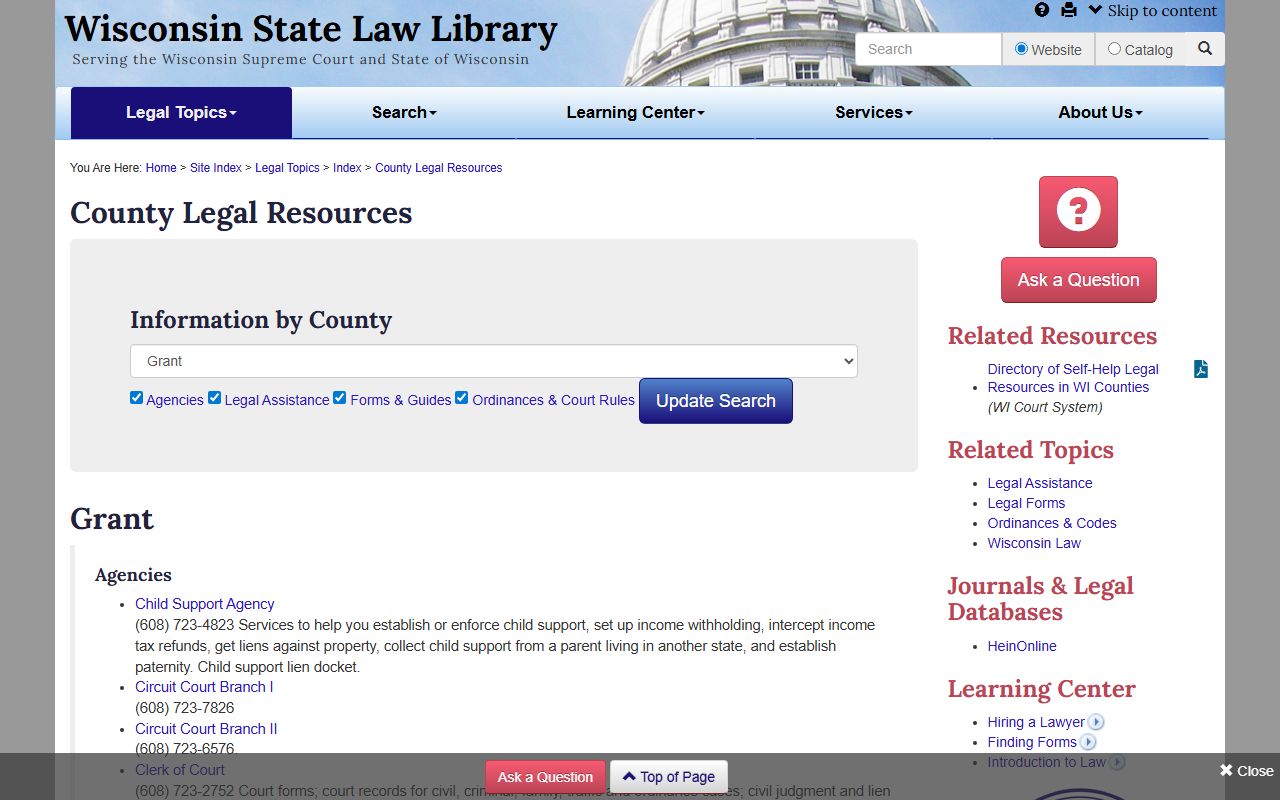
The image points back to the county legal resources page, which is a useful reminder that Grant County users can start from a local legal reference page and then move into WCCA or the courthouse file as needed.
Grant County Court Docket Copies
Copy work in Grant County follows the statewide fee rules. Wis. Stat. § 814.61 sets the baseline for court copy costs and certification charges, so the clerk can explain the total once the office knows what you want copied. That usually means a plain docket printout costs less than a certified judgment or an older packet of filings. If the document is going to another court, a bank, or an agency, certification is often worth the extra step. If you only need to track the history of the case, a docket copy may be enough.
Grant County users should be specific in the request. Name the parties, list the case number if you know it, and identify the document if you need one document rather than the whole file. In-person requests are the simplest when you can get to Lancaster. Mail requests work when you include enough detail for the clerk to identify the case without guesswork. If the office has to search without a case number, you may need to use the statewide name-search fee rule. A clear request is faster than a broad one every time.
The county clerk handles the records side of the process, while WCCA handles the search side. That split is normal. It lets you confirm the docket online, then go straight to the office for the copy you actually need. If the file has old paper, archived pages, or a branch-specific order, the clerk can tell you what is available and whether additional time is needed. That keeps the Grant County process manageable even when the case is older or more complex.
Open Records and Retention
The public records policy in Wis. Stat. § 19.31 explains why county dockets are open in the first place. Wisconsin says access should be the rule and denial the exception. For Grant County Court Docket users, that means most public docket information is available unless a confidentiality rule blocks it. Sealed matters, juvenile files, and some family records can still be limited, so the public view is broad but not unlimited. That is the normal shape of public court access.
Wisconsin Supreme Court Rule 72 gives the retention side of the picture. Clerks keep records under approved schedules, and those schedules vary by case type. A Grant County record can still exist even if the paper file is stored off-site or the online docket is the only quick view. Electronic retention is allowed, but the rule requires secure backup and proper maintenance. That helps keep older Grant County matters available even after the active file moves out of the day-to-day office stack.
The public-access rule and the retention rule work together. One tells you what should be open. The other tells you how long the record must remain available. If the docket is public but a specific document is restricted, the clerk can explain the limit. If the record is archived, the clerk can explain how to get it back into view. That is why the county office and the statewide rules should both be part of the search plan.
Note: Grant County docket access is broad, but older paper files and sealed matters may require a formal request or may remain restricted.
Grant County Court Docket Help
Grant County Court Docket searches sometimes lead to questions that are not record questions at all. If the issue is criminal representation, the Wisconsin State Public Defender is the statewide office that handles eligible indigent defense. That office does not search the docket for you, but it matters when a record leads to a live case and the person needs counsel. The same is true for the Wisconsin Department of Justice Crime Information Bureau. It handles statewide criminal history data, not circuit court docket access, so it should be treated as a separate tool.
The county clerk of courts is still the main office for local records, branch calendars, and certified copies. If you are trying to line up a hearing, match a notice, or confirm whether a judgment was entered, the clerk is the right place to finish the search. If you need legal advice, the clerk cannot provide it. If you need a record, the clerk can usually point you in the right direction. That clear split keeps Grant County docket work efficient.
The local legal resources page, the statewide docket portal, and the court records rules all point in the same direction. They help you move from search to confirmation to copy without making the process harder than it needs to be. For Grant County, that is usually enough to get the docket answer you were after in the first place.