
Search Kenosha Court Docket
Kenosha Court Docket searches usually begin with the city municipal court because that court handles the non-criminal traffic and local ordinance side of the city record. It is a busy court with a regular morning calendar, a clear hearing rhythm, and a large volume of citations each year. If you are looking for a hearing date, a motion to reopen, a truancy matter, or a citation that still needs a response, the city court is the place to start. If the case becomes a county matter, the circuit court and the county clerk take over.
Kenosha Court Docket Overview
The City of Kenosha Municipal Court adjudicates all non-criminal traffic and local ordinance violations in the city. The official city budget materials put the court at 625 52nd Street, Kenosha, WI 53140 and describe court sessions as weekday mornings from 8:30 a.m. until noon. The court has one municipal judge, a small clerk staff, and a court officer from the police department who oversees initial appearances and certain hearings. In the city budget description, roughly 75 percent of cases are traffic related and the rest involve city ordinance violations.
The court also handles juvenile jurisdiction for individuals aged 12 to 16 and gives special attention to truancy matters, indigence hearings, motions to suppress evidence, motions to reopen, and motions to modify a sentence. That means a Kenosha Court Docket search is often about more than just a fine. It can be about the next hearing slot, whether the case can be reopened, or whether the city has already moved from an initial appearance into a later motion track. The city also allows telephonic and Zoom appearances in many situations, which makes the docket even more practical for people who cannot be there in person.
Because the court is municipal, the record path is different from a county circuit record. The city handles the citation and the first response. The county handles the appeal and broader circuit matter if the case moves that far.
Searching Kenosha Court Docket
The Wisconsin Court System's municipal court page is a helpful statewide guide because it explains where municipal courts fit in the state system and why they handle ordinance-level matters. Kenosha fits that pattern, and the city budget materials make the local workflow clearer than a generic court listing. If you need to know whether a citation is still active, the municipal office and the city court calendar are the first places to check. If the matter is still open, the court can tell you whether you need to appear, pay, or file something in writing.
For Kenosha Court Docket users, motions to reopen and motions to modify are important because the court specifically schedules them on Monday mornings after the initial appearance window. That is a clue that the docket is motion-driven, not just payment-driven. The court also hears truancy matters on Tuesday mornings and tries cases Wednesday through Friday. That structure helps you map the citation to the right week instead of guessing at the next available date.
If a case goes unpaid or unresolved, the city budget materials say the court can use suspension of driving privileges, tax interception, independent collections, the state debt collection initiative, incarceration, and judgment docketing with the Kenosha County Clerk of Courts. That is why Kenosha Court Docket searches are often about both court status and collection status at the same time. The county side of the record can also be checked through WCCA once the case moves out of the city office.
Kenosha Image Guide
The Kenosha County legal resources page at wilawlibrary.gov/topics/county.php?c=Kenosha&a=a&l=l&f=f&r=r gives Kenosha Court Docket users a county legal starting point when the city case has to move beyond the municipal office.
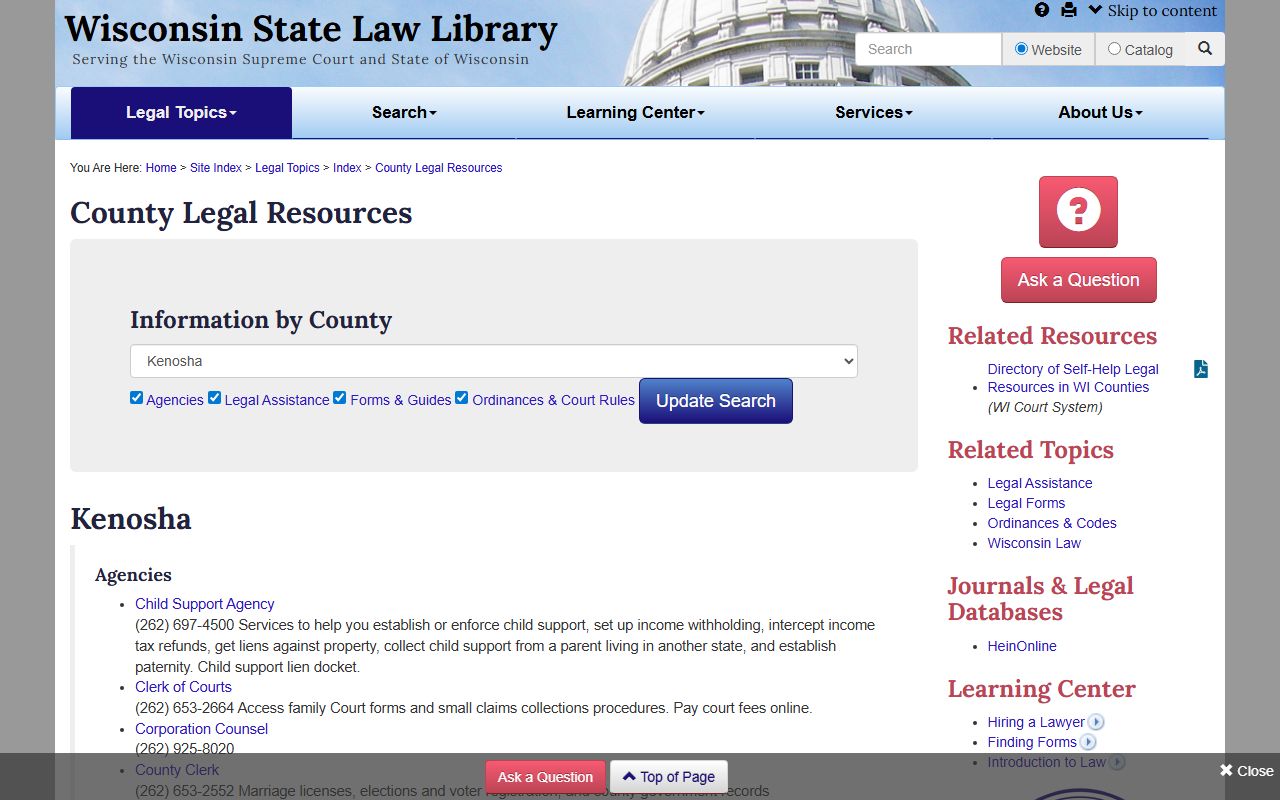
That page is useful when the city citation becomes a county appeal or a circuit file.
Kenosha County Records
When a Kenosha municipal case moves to circuit court, the county court at 912 56th Street becomes the next record stop. The county expanded detail says Kenosha County also has specialized courts, including Drug Court, Veterans Court, and family court programs. That matters because a city citation can turn into a county matter once the city court is done with its part. The city budget documents also note that judgment docketing can be handled through the Kenosha County Clerk of Courts, which is one more sign that the city and county records are linked even though they are not the same file.
If you are searching a Kenosha Court Docket and the city case has already moved into the county layer, WCCA is the right statewide portal to check next. The city citation tells you where the municipal case stood. The county system tells you whether it became a circuit filing or a later court matter. That is the cleanest way to tell a city ordinance case from a county court record.
For hearing questions, the city court is still the first call. For appeal or county-file questions, the county circuit court becomes the better fit.
Kenosha Court Docket Requests
The city's official budget materials from kenosha.org/2025Proposed.pdf describe the municipal court record-keeping role, the hearing schedule, and the ways the court collects forfeitures. That makes the budget PDF a practical source when you want to understand how Kenosha Court Docket records are handled even when the city court does not have a separate public records page in the research file. Because the office collects, schedules, and dockets cases, your request should match the stage the case is actually in.
For many people, the fastest request is a phone call to confirm the hearing date and the office process, then a written follow-up if the case needs to be reopened or the judgment needs to be docketed. If the matter has already been handled by the court, the city may direct you to the county clerk or the collection path. That is normal in Kenosha because the city court works closely with county collections and circuit docketing when a citation is not resolved on time.
A good Kenosha Court Docket request stays narrow. Ask for the citation status, the hearing date, or the motion you need. If the case has moved to county court, switch to the county system. That keeps the city and county searches in the right order.